By Jennifer Williamson L6
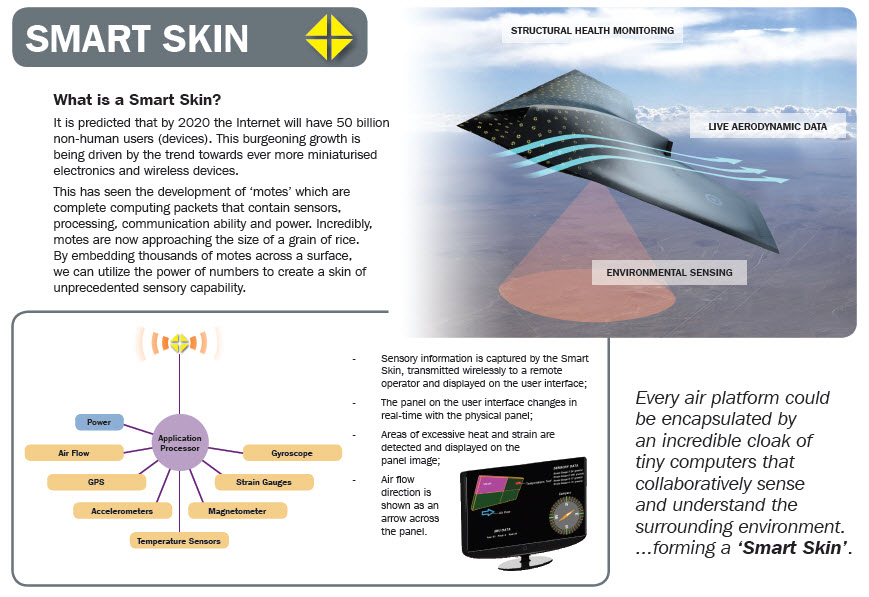
Work is underway at BAE Systems to give aircraft human-like ‘skin’, enabling the detection of injury or damage and the ability to ‘feel’ the world around them.
This technology, currently being developed by the Advanced Technology Centre, would enable the aircraft to sense wind speed, temperature, physical strain and movement, to a far higher degree of accuracy than presently possible.
The health of the aircraft could thus be continually monitored, enabling potential problems to be detected and reported back on before they became a danger. On-ground check-ups would become more infrequent, and aircraft maintenance would become more efficient. This would improve not only the safety but also the availability of the aircraft.
The ‘smart skin’ would consist of tens of thousands of micro sensors or ‘motes’; at less than 1mm squared, these motes are complete computing packages containing sensors, processing, communication ability and power. In just the same way that receptors on the skin transmit information from environmental stimuli to the brain, these sensors, when used in conjunction with the appropriate software, would be able to communicate vital information concerning the aircraft. Another advantage of using such small sensors is that it opens us the possibility of retrofitting them to existing aircraft, or even spraying them onto aircraft as is done with paint.
Senior Research Scientist Lydia Hyde, who is leading the research and development and whose idea came to her when she observed her tumble dryer preventing itself from overheating via a sensor, explains her aspirations for the technology: “By combining the outputs of thousands of sensors with big data analysis, the technology has the potential to be a game-changer for the UK industry. In the future we could see more robust defence platforms that are capable of more complex missions whilst reducing the need for routine maintenance checks. There are also wider civilian applications for the concept which we are exploring.”
The research forms part of a range of new systems being investigated under a major programme exploring next-generation technology for air platforms.